Showing posts with label My own work. Show all posts

Saturday, October 24, 2026

The original Mars Colonization Timeline, published in October 2016

Ten years ago, in October 2016, we published the 1st version of the Mars Colonization Timeline – our speculative timeline for Mars exploration and colonization, blending optimistic tech forecasts with real-world progress. Since its debut, the timeline has always been the most popular section on humanMars.net, dozens tune in daily, inspired by the possibilities awaiting us on the Red Planet.

As the timeline is regularly updated and expanded – taking into account real-world developments in technology, as well as plans for the exploration and colonization of Mars – it now differs significantly from the version originally published. For this reason, we thought it would be interesting to revisit the original Mars Colonization Timeline, published in October 2016, and share it with you. Here it will stay unchanged forever.

Go to: 2020s – 2030s – 2040s – 2050s – 2060s – 2070s – 2080s – 2090s – 22nd century

2010s – The Mars hype is there


2016 – Elon Musk reveals SpaceX plans for the Interplanetary Transport System (ITS, formerly known as Mars Colonial Transporter).
2016 – ESA&Roscosmos's ExoMars Trace Gas Orbiter enters Mars orbit, but Schiaparelli lander crashes on the surface of Mars.
2018 – NASA's InSight lander lands on Mars.
2018 – SpaceX's Red Dragon becomes the first private spacecraft to land on Mars, and the largest overall.

2020s – Preparing for human arrival


Mars Colonization Timeline - 2020s
2021 – ESA&Roscosmos's ExoMars rover lands on Mars.
2021 – NASA's Mars 2020 rover lands on Mars.
2021 – First Chinese orbiter, lander and rover reaches Mars.
2021 – 2nd Red Dragon lands on Mars with a drill and an experimental propellant plant to produce oxygen and methane from Martian atmosphere and soil.
2021 – United Arab Emirates Hope probe enters Mars orbit.
2022 – Two communications satellites are placed in Sun-Earth Lagrangian points L4 and L5 to overcome the problem of periodic communications blackout with spacecraft temporarily behind the Sun.
2022 – The location for SpaceX's future "Mars Base Alpha" is selected.
2023 – NASA's next generation (solar electric ion thrusters, broadband laser communications) satellite enters Mars orbit.
2023 – Japan's Martian Moons Explorer lands on Phobos to collect samples and return them to Earth.
2023 – 3rd Red Dragon lands on Mars with deployable solar panels and In Situ Resource Utilization (ISRU) system containing a chemical plant to produce water and nitrogen and an improved propellant plant (capable of producing and storing liquid methane and oxygen).
2024 – SpaceX's ITS makes its first unmanned test flight.
2025 – A group of unmanned Red Dragons lands near the selected location of future Mars Base Alpha with an improved ISRU system, deployable solar panels and experimental greenhouse; they are automatically interconnected to make a single system.
2025 – Another Red Dragon lands on Mars to retrieve samples collected by Mars 2020 rover and launch them back to Earth.
2027 – The first unmanned demonstration ITS spaceship "Heart of Gold" lands on Mars near the location of future Mars Base Alpha; basic post-landing procedures are tested, the ship refills itself with propellant (by an upscaled automatic ISRU system) and launches back to Earth.
2029 – Several unmanned ITS spaceships lands at Mars Base Alpha: a backup crew ship (which can serve as a temporary habitat), a cargo ship with ISRU system, small nuclear power reactor and deployable solar panels and a few cargo ships with rovers, miner/ tunneling droids and parts for a modular habitat and other equipment.
2029 – Some of the modules for NASA's Mars Base Camp (a manned station orbiting Mars built in collaboration with Lockheed Martin and Boeing) are prepositioned in Mars orbit.

Wednesday, July 15, 2026

Mars Colonization Timeline – Short Version

Mars Colonization Timeline

Have you ever imagined how humanity will explore and gradually settle the closest potentially habitable planet to Earth? Here we have created a speculative timeline of human exploration and colonization of Mars, blending optimistic tech forecasts with real-world progress. This is the SHORT VERSION of the full Mars Colonization Timeline, which you can explore HERE. The timeline, first published in October 2016, is regularly updated to reflect the latest developments.

Mars Colonization Timeline – 2010s – Humanity regaining interest in Mars
Humanity's interest in Mars sparks anew in the 2010s as Curiosity drills into Gale Crater sediments that preserve records of ancient lakes, The Martian dramatizes the daily realities of living off local resources, and SpaceX reveals Starship plans while flying early prototypes. Robotic orbiters continue to explore the Red Planet from above while InSight lands to measure marsquakes and subsurface heat. These scientific returns, cultural reach and prototype hardware steps together rebuild the case for sending people to stay rather than only to observe.

SpaceX Mars Colonization Timeline – 2020s – Laying the groundwork for human arrival
The 2020s mark a surge in robotic exploration as Perseverance rover caches samples in Jezero Crater with Ingenuity proving sustained flight in the thin Martian air, and China delivers its first mission to Mars. SpaceX Starship advances through orbital tests, in-orbit refueling demonstrations and lunar cargo missions while early uncrewed vehicles attempt Mars landings and Marslink satellites begin a dedicated communications network. These efforts convert earlier visions into flight-proven transport chains and precursor systems ready for crewed arrival.

SpaceX Mars Colonization Timeline – 2030s – First humans on Mars
By 2035 the 2030s deliver humanity's first sustained presence on Mars when crews land at sites prepared by robotic forerunners and activate Mars Base Alpha with in-situ resource utilization plants, solar power arrays and nascent greenhouses. The initial teams focus on habitat expansion, water extraction and the first return flights that close the Earth-Mars loop, turning a fragile outpost into the foundation for permanent settlement. In parallel, the US and China are developing their separate bases in the Lunar South Pole region, competing for a dominant foothold there.

Wednesday, December 24, 2025

Merry Christmas to all Martians!

Merry Christmas to all Martians!

Created using Grok Imagine by xAI

P.S. It's incredible how fast the AI text-to-image generation has evolved recently. Only a few years ago you couldn't generate such image without deep knowledge of the right tools, now it's accessible to anyone.

Wednesday, March 4, 2015

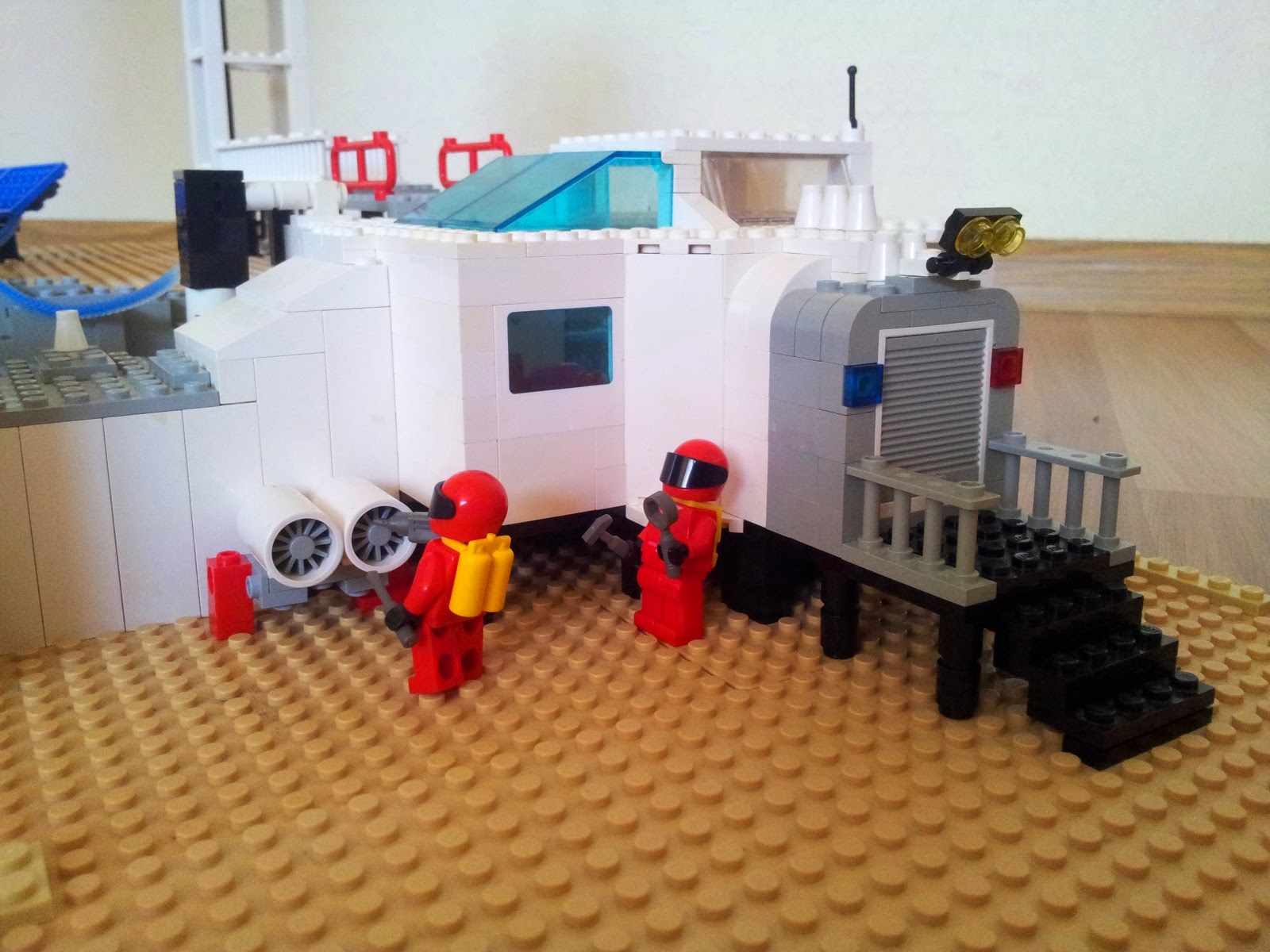
My LEGO Mars colony #2

When I finished my 1st LEGO Mars base back in April, 2014 (inspired from GRusso's idea for a LEGO Mars base) my boys were telling it's too small :) So now I pulled oneself together to build a bigger one - one which you could call even a small "colony" not only a "base". Part of the colony (the living quarters and some of the maintenance facilities) is hidden underground a mountain for better protection from radioactivity. Click to view in full resolution:

LEGO Mars colonyLEGO Mars colony

LEGO Mars colonyLEGO Mars colony

Sunday, April 27, 2014

My LEGO Mars base

Inspired from GRusso's idea for a LEGO Mars base, I built one by myself from my old LEGO bricks.

Note that I don't have any pack of space themed LEGO's so I had to improvise a lot. Most pressing was the absence of big windows for the greenhouse and appropriate hermetic-looking doors. Click to view in full resolution:

LEGO Mars baseLEGO Mars base

LEGO Mars baseLEGO Mars base greenhouse

Friday, March 28, 2014

Toponymic MAP of Mars

When reading Kim Stanley Robinson's Mars trilogy I tried to find in the web a good map of Mars with enough toponyms to print out and effectively follow the story. I didn't found one. There were a few with the very basic toponymy of Mars but none to really follow the geographically rich story of Red Mars, Green Mars and Blue Mars. So I made one by myself collecting a lot of data from various maps including Google Mars. Feel free to use and share it :)

Map of Mars with toponyms