Showing posts with label Moon Base Alpha. Show all posts

Saturday, May 23, 2026

SpaceX' vision for Cislunar and Martian economy, according to its IPO filing

In its May 2026 S-1 IPO registration statement, SpaceX presents a clear, long-term economic roadmap that goes far beyond launch services. The company frames its mission as “building the systems and technologies necessary to make life multiplanetary,” with Starship positioned as the foundational infrastructure for a new space-based economy spanning Cislunar space (Earth-Moon system) and eventually Mars.

Cislunar Economy

SpaceX Starships at Artemis Base Camp

SpaceX describes the Moon and surrounding space as the first practical layer of this economy. Key activities explicitly referenced or implied include:
  • Cargo and passenger transportation: Regular Starship flights to the lunar surface, initially in support of NASA’s Artemis program, evolving into commercial cargo delivery and crew rotation.
  • Space tourism: High-end lunar orbital and surface missions for private customers.
  • Lunar bases and infrastructure: Establishment of permanent outposts serving as resource extraction sites, propellant depots, and potential spaceports. The filing positions the Moon as a critical “stepping stone” for deeper space operations, enabling in-situ resource utilization (ISRU) such as oxygen and water production from lunar ice.
  • Orbital services: The S-1 highlights growing demand for satellite deployment, maintenance, and space-based manufacturing in Earth orbit and cislunar space.
These activities are presented as nearer-term, commercially viable stepping stones that can generate revenue while maturing Starship technology.

Martian Economy

SpaceX's vision for a City on Mars

Mars is described as the ultimate destination and the centerpiece of SpaceX’s multiplanetary vision. The filing outlines an ambitious Martian economy built on:
  • Cargo and passenger transportation: Large-scale Starship fleets capable of carrying hundreds of people and thousands of tons of cargo per synodic window, enabling sustained settlement.
  • Mars bases and self-sustaining colonies: Permanent human settlements that evolve into cities, with explicit references to energy production (solar and nuclear), manufacturing capabilities, and interplanetary industrialization on the Martian surface.
  • Resource utilization and expansion: In-situ production of fuel, oxygen, water, and construction materials from Martian regolith and ice, reducing Earth dependency over time.
  • Broader interplanetary activities: While not listed in detail, the S-1 alludes to future markets including asteroid mining support (as part of deeper-space logistics) and the general industrialization of Mars as humanity’s “backup” civilization.
The document repeatedly cautions that these Martian markets “do not exist today” and may take decades to become commercially viable. While the S-1 is bullish on the long-term opportunity, it is filled with standard SEC risk-factor language warning that Starship development delays, technical failures, or slower-than-expected market adoption could significantly postpone or prevent these visions from materializing.

Musk’s compensation

To underscore the seriousness of the Mars vision, the S-1 discloses Elon Musk’s performance-based compensation package: a grant of 1 billion Class B shares (with 10x voting power each), vesting in 15 tranches only when both aggressive market-capitalization milestones (up to $7.5 trillion) and the establishment of a “permanent human colony on Mars with at least one million inhabitants” are achieved. This ties Musk’s personal financial upside directly to the creation of a self-sustaining Martian civilization.

Thursday, February 12, 2026

SpaceX mass driver at Moonbase Alpha

A render of SpaceX mass driver at Moonbase Alpha to launch Moon-made AI satellites (data centers) into orbit. The render was included in Elon Musk's presentation yesterday at xAI All Hands meeting.

SpaceX mass driver at Moonbase Alpha

A lunar mass driver is a proposed electromagnetic launch system optimized for the Moon’s low gravity (1/6th Earth’s) and hard vacuum, consisting of a long, straight acceleration track (typically several to tens of kilometers) lined with sequentially fired superconducting coils or linear synchronous motors that propel a payload-carrying sled or bucket to lunar escape velocity (~2.38 km/s). The track is usually elevated on supports or aligned along a natural slope (e.g., crater rim) to achieve the desired trajectory. Payloads experience continuous acceleration (potentially 20-100 g for brief periods) without atmospheric drag or chemical propellant expenditure, enabling theoretically high throughput at far lower recurring cost than rockets. Practical challenges include the immense construction effort, precise alignment for orbital insertion, recoil management into the lunar surface, and the energy storage needed for rapid repetitive launches.

Sunday, November 8, 2020

Lunar mining colony by Jort van Welbergen

Picture of the Day 8/11/2020 - Lunar mining colony with several landing pads for SpaceX's Starships (pictured here in their 2017 design, then called Big Falcon Ship) by Dutch freelance movie and game concept designer Jort van Welbergen. More of his art here.

Lunar mining colony by Jort van Welbergen
Closeup of one of the Starship landing pads with Earth on the horizon:
SpaceX's Starship landing pad at Lunar colony by Jort van Welbergen

Sunday, October 4, 2020

SpaceX Starship at NASA Artemis Base Camp by ICON

NASA has announced it is working with Texas-based 3D printed construction startup ICON "on early research and development of a space-based construction system that could support future exploration of the Moon and Mars. The company has 3D printed communities of homes and structures on Earth and participated in NASA’s 3D-Printed Habitat Challenge, demonstrating a construction method and technologies that may be adaptable for applications beyond our home planet." Both NASA and US Air Force have invested in company's technologies via Small Business Innovation Research (SBIR) contract.

NASA is working, via its Artemis program, to establish a long-term human presence on and around the Moon by the end of the 2020s. Construction and expansion of Artemis Base Camp will require extensive use of lunar resources, including water ice (for life support and rocket fuel) and moon dirt (for building materials).

To accomplish goals of the SBIR contract ICON has teamed up with space design studio SEArch+ and Danish architecture firm BIG in Project Olympus to develop robotic construction concept for NASA's Artemis Base Camp. Here are several conceptual illustrations from the project.
First one depicts a spaceport featuring several 3D printed landing pads and roads, SpaceX's Starship in one of the pads and Blue Origin's Lunar lander with ICON's 3D printer landing in another:
SpaceX's Starship at NASA's Artemis Base Camp spaceport by ICON & SEArch+
Closeup of illustration's central part:
SpaceX's Starship at NASA's Artemis Base Camp spaceport by ICON & SEArch+ - closeup
Here are illustrations of 3D printed habitats:
Project Olympus concept by ICON & BIG for NASA's Artemis Base Camp - top view

Monday, September 30, 2019

Human colony on the Moon

Picture of the Day 30/9/2019 - Supplied by regular SpaceX's Starship flights, Moon Base Alpha has grown into a large human colony with dome-shaped habitat complexes in the center, surrounded in semi-circle by industrial area and solar array - a closeup from the Lunar colony render in Elon Musk's recent Starship update presentation.

Human colony on the Moon

Saturday, September 28, 2019

Slides from SpaceX Starship 2019 update presentation by Elon Musk

Today SpaceX CEO and lead designer Elon Musk provided an update of SpaceX's Starship design. Here are slides and animations from his presentation (open link in new tab to view image in full resolution).
Basic info about the new Starship:
Basic info about the SpaceX's new Starship
Layout of Starship Raptor engines:
Layout of SpaceX's Starship Raptor engines
Super Heavy booster layout:
SpaceX's Super Heavy booster layout
Starship comparison with Starhopper and Millennium Falcon:
SpaceX's Starship comparison with Starhopper and Millennium Falcon

Wednesday, July 17, 2019

HD quality official renders of SpaceX Starship at Mars Base Alpha and on the Moon

In April Elon Musk on his Twitter profile teased two new renders with SpaceX's Starship on the Moon and at Mars Base Alpha. Unfortunately those were low resolution images. Now we have a HD resolution versions (press Open link in new tab to view) of those renders from SpaceX's Principal Mars Development Engineer Paul Wooster's presentation at Humans to Mars summit 2019 organized by Explore Mars.

SpaceX Starship at Mars Base Alpha HD

SpaceX Starship on the Moon HD

Monday, June 3, 2019

SpaceX Starship at Moon Base Alpha by Sam Taylor

Picture of the Day 3/6/2019 - Poster of a dozen starmen (with white&black suits) & starwomen (with white&pink suits) working around SpaceX's Starship at Moon Base Alpha by digital artist Sam Taylor. More of his art here.

Poster of SpaceX Starship at Moon Base Alpha by Sam Taylor

Monday, April 29, 2019

Sunday, April 22, 2018

Unloading cargo from SpaceX BFR spaceship on the Moon

Picture of the Day 22/4/2018 - Unloading cargo from SpaceX BFR spaceship (BFS) on the Moon; fan vision by Reddit user brickmack (Mack Crawford).
(Open link in new tab to view ⇩ in full resolution)
Unloading cargo from SpaceX BFR spaceship at Moon Base Alpha

Saturday, October 28, 2017

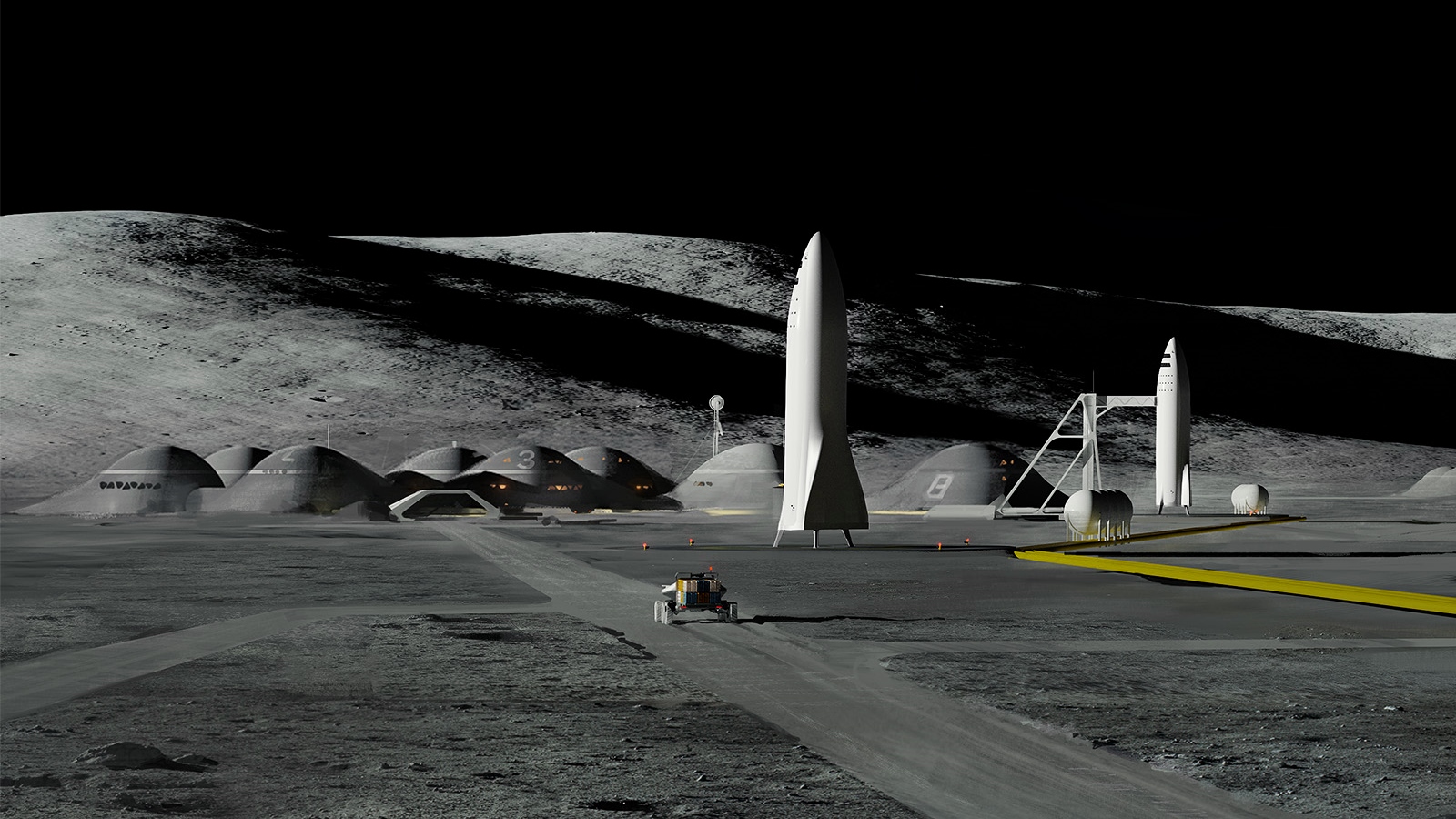
SpaceX Moon Base Alpha

Picture of the Day 28/10/2017 - human base on the Moon, featuring a group of habitats covered with a layer of lunar regolith and a skybridge for easy access to landed SpaceX's BFR spaceships (BFS) - a closeup from official Moon Base Alpha concept image by SpaceX.

SpaceX Moon Base Alpha

Friday, September 29, 2017

"Making life multiplanetary". Official schematics for BFR by Elon Musk, SpaceX

SpaceX BFR Mars transportation architecture
Today SpaceX CEO and lead designer Elon Musk provided an update of SpaceX vision to make life multiplanetary and colonize Mars. Previous name for the colonization class SpaceX booster&spaceship - "Interplanetary Transport System" - has been dropped and now Musk referred to it by the old acronym - BFR*.

Here are video, schematics and images from his presentation (open link in new tab to view image in full resolution):


Lunar surface missions:


SpaceX BFR Lunar surface missionsSpaceX Moon Base Alpha

SpaceX Mars mission architecture and Mars Base Alpha buildup:


SpaceX BFR Mars transportation architectureSpaceX Mars mission early timeline