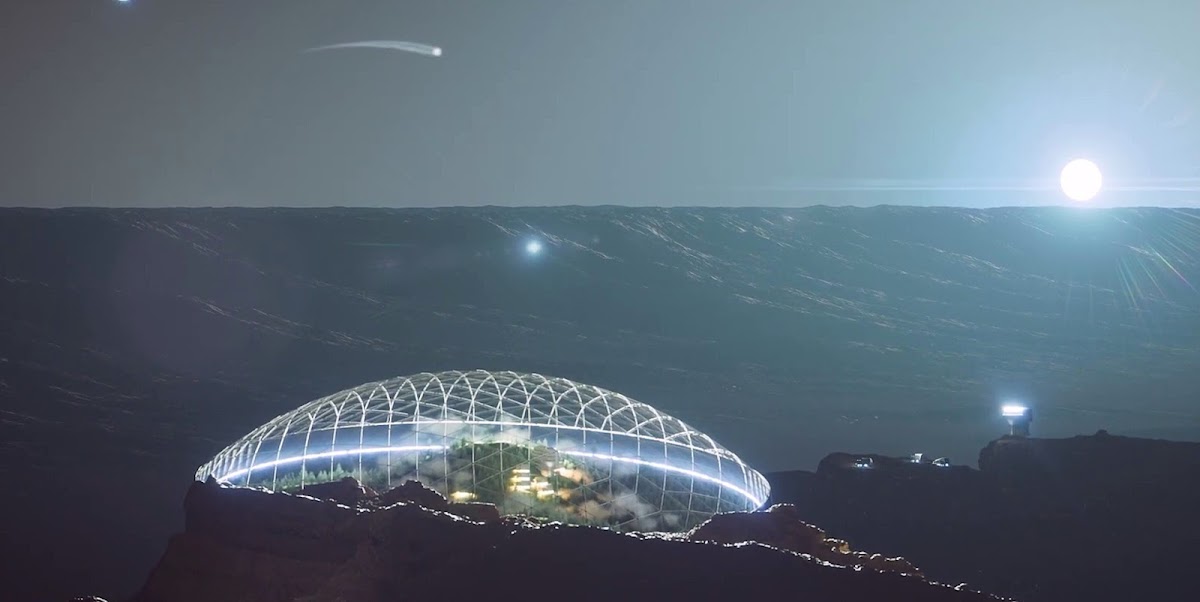
Several renders of SpaceX electromagnetic mass driver at Moonbase Alpha to launch Moon-made AI satellites (data centers) into orbit. The renders are from an animation [you can watch at the end of the post] which was demonstrated during Elon Musk's Terrafab presentation on March 22, 2026.
A lunar mass driver is a proposed electromagnetic launch system optimized for the Moon’s low gravity (1/6th Earth’s) and hard vacuum, consisting of a long, straight acceleration track (typically several to tens of kilometers) lined with sequentially fired superconducting coils or linear synchronous motors that propel a payload-carrying sled or bucket to lunar escape velocity (~2.38 km/s). The track is usually elevated on supports or aligned along a natural slope (e.g., crater rim) to achieve the desired trajectory. Payloads experience continuous acceleration (potentially 20-100 g for brief periods) without atmospheric drag or chemical propellant expenditure, enabling theoretically high throughput at far lower recurring cost than rockets. Practical challenges include the immense construction effort, precise alignment for orbital insertion, recoil management into the lunar surface, and the energy storage needed for rapid repetitive launches.
Showing posts with label Elon Musk. Show all posts
Sunday, September 20, 2026
Saturday, May 23, 2026
SpaceX' vision for Cislunar and Martian economy, according to its IPO filing
In its May 2026 S-1 IPO registration statement, SpaceX presents a clear, long-term economic roadmap that goes far beyond launch services. The company frames its mission as “building the systems and technologies necessary to make life multiplanetary,” with Starship positioned as the foundational infrastructure for a new space-based economy spanning Cislunar space (Earth-Moon system) and eventually Mars.
SpaceX describes the Moon and surrounding space as the first practical layer of this economy. Key activities explicitly referenced or implied include:
Mars is described as the ultimate destination and the centerpiece of SpaceX’s multiplanetary vision. The filing outlines an ambitious Martian economy built on:
To underscore the seriousness of the Mars vision, the S-1 discloses Elon Musk’s performance-based compensation package: a grant of 1 billion Class B shares (with 10x voting power each), vesting in 15 tranches only when both aggressive market-capitalization milestones (up to $7.5 trillion) and the establishment of a “permanent human colony on Mars with at least one million inhabitants” are achieved. This ties Musk’s personal financial upside directly to the creation of a self-sustaining Martian civilization.
Cislunar Economy
SpaceX describes the Moon and surrounding space as the first practical layer of this economy. Key activities explicitly referenced or implied include:
- Cargo and passenger transportation: Regular Starship flights to the lunar surface, initially in support of NASA’s Artemis program, evolving into commercial cargo delivery and crew rotation.
- Space tourism: High-end lunar orbital and surface missions for private customers.
- Lunar bases and infrastructure: Establishment of permanent outposts serving as resource extraction sites, propellant depots, and potential spaceports. The filing positions the Moon as a critical “stepping stone” for deeper space operations, enabling in-situ resource utilization (ISRU) such as oxygen and water production from lunar ice.
- Orbital services: The S-1 highlights growing demand for satellite deployment, maintenance, and space-based manufacturing in Earth orbit and cislunar space.
Martian Economy
Mars is described as the ultimate destination and the centerpiece of SpaceX’s multiplanetary vision. The filing outlines an ambitious Martian economy built on:
- Cargo and passenger transportation: Large-scale Starship fleets capable of carrying hundreds of people and thousands of tons of cargo per synodic window, enabling sustained settlement.
- Mars bases and self-sustaining colonies: Permanent human settlements that evolve into cities, with explicit references to energy production (solar and nuclear), manufacturing capabilities, and interplanetary industrialization on the Martian surface.
- Resource utilization and expansion: In-situ production of fuel, oxygen, water, and construction materials from Martian regolith and ice, reducing Earth dependency over time.
- Broader interplanetary activities: While not listed in detail, the S-1 alludes to future markets including asteroid mining support (as part of deeper-space logistics) and the general industrialization of Mars as humanity’s “backup” civilization.
Musk’s compensation
Thursday, February 12, 2026
SpaceX mass driver at Moonbase Alpha
A render of SpaceX mass driver at Moonbase Alpha to launch Moon-made AI satellites (data centers) into orbit. The render was included in Elon Musk's presentation yesterday at xAI All Hands meeting.
A lunar mass driver is a proposed electromagnetic launch system optimized for the Moon’s low gravity (1/6th Earth’s) and hard vacuum, consisting of a long, straight acceleration track (typically several to tens of kilometers) lined with sequentially fired superconducting coils or linear synchronous motors that propel a payload-carrying sled or bucket to lunar escape velocity (~2.38 km/s). The track is usually elevated on supports or aligned along a natural slope (e.g., crater rim) to achieve the desired trajectory. Payloads experience continuous acceleration (potentially 20-100 g for brief periods) without atmospheric drag or chemical propellant expenditure, enabling theoretically high throughput at far lower recurring cost than rockets. Practical challenges include the immense construction effort, precise alignment for orbital insertion, recoil management into the lunar surface, and the energy storage needed for rapid repetitive launches.
Friday, May 30, 2025
SpaceX Starship Mars mission update 2025
On May 29th at Starbase, Texas SpaceX CEO and lead designer Elon Musk provided an update of SpaceX's Starship Mars architecture "The Road to Making Life Multiplanetary". Here are slides from his presentation.
Full presentation:
Slides from the presentation
Starship mission timeline for next 4 Earth-Mars transfer windows every 26 months:
The next opportunity is in the end of 2026, with landing in 2027:
SpaceX Mars mission in 2026:
SpaceX Mars mission in 2028:
Saturday, April 13, 2024
SpaceX Starship update 2024
On April 4th at Starbase, Texas SpaceX CEO and lead designer Elon Musk provided an unannounced update of SpaceX's Starship architecture. Here are slides and animations from his presentation.
Full presentation:
Slides from the presentation
Starship v1, v2 and v3 specifications:
Thrust comparison of Raptor v1, v2 and v3:
First Mechazilla launch tower pairs at Starbase, Texas and Cape Canaveral, Florida:
Saturday, February 12, 2022
Elon's latest vision for Mars Base Alpha
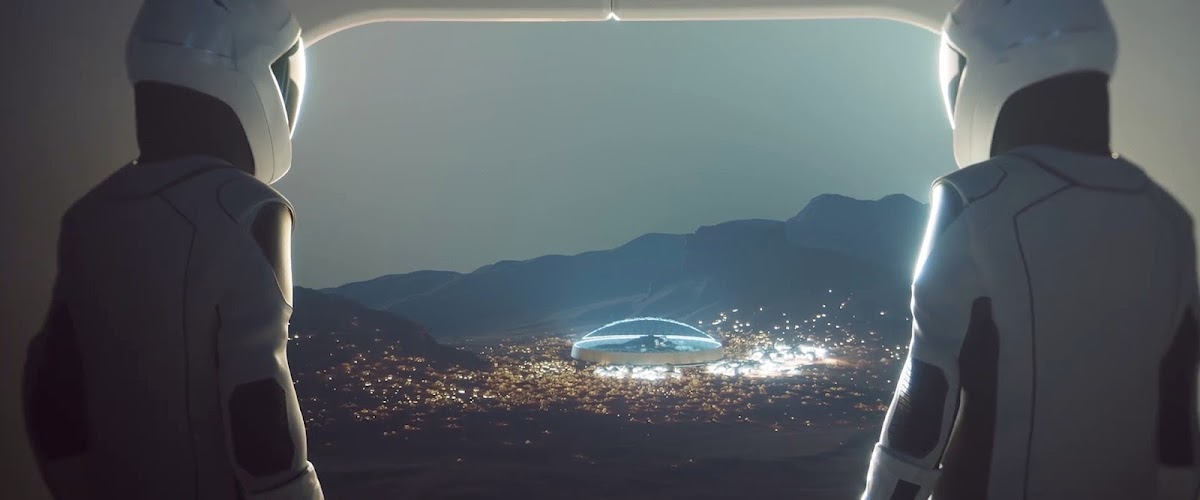
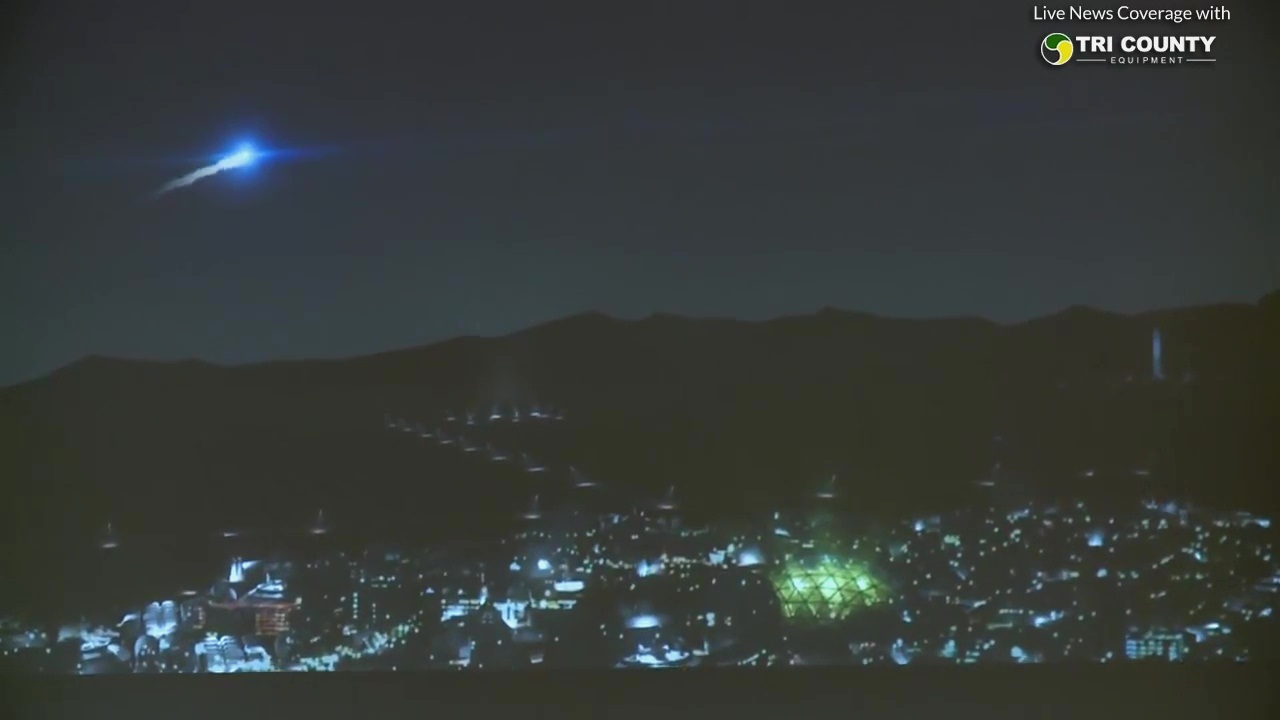
During Starship update presentation on Thursday SpaceX CEO and lead designer Elon Musk shared to us SpaceX's latest vision for Mars Base Alpha. Here are some images from the animation.
Part of Mars Base Alpha is covered with a large, transparent dome:
Starships are landing on landing pads some distance away from the base:
Settlers arriving at Mars Base Alpha:
Animation of Starship landing at Mars Base Alpha shared by Elon:
Friday, February 11, 2022
SpaceX Starship update 2022
Animation of Starship launch and arrival to Mars Base Alpha [updated on April 2023]:
Full presentation:
Slides from the presentation
Starship specifications:
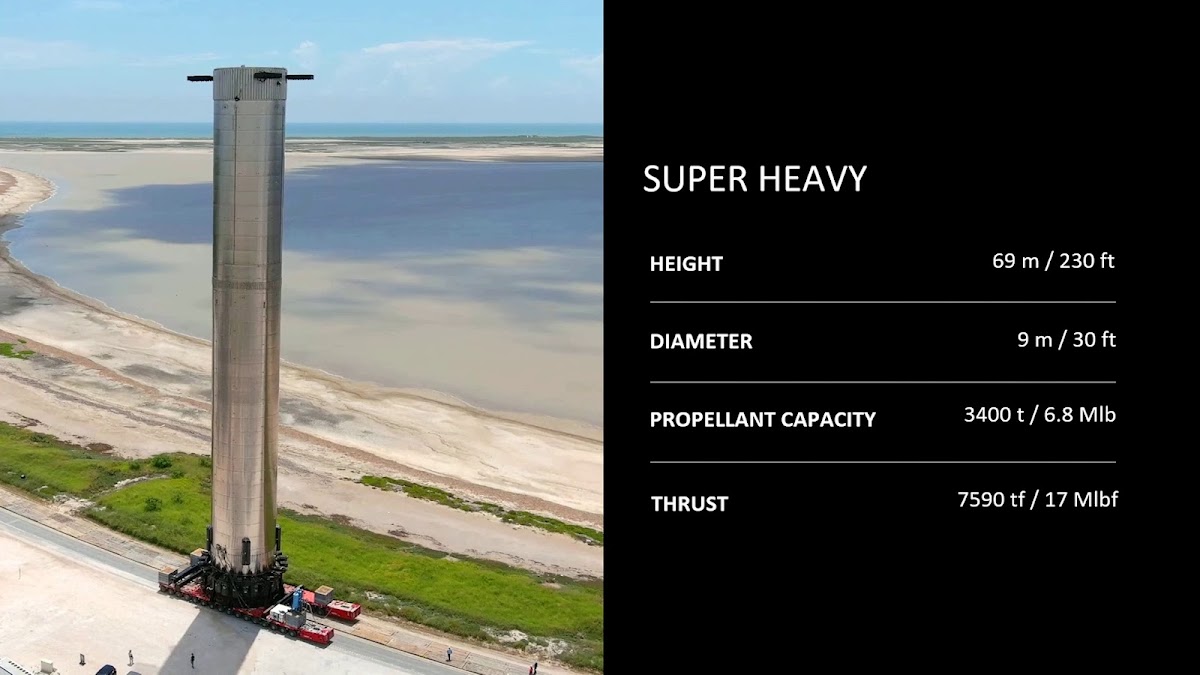
Super Heavy booster specifications:
Wednesday, August 18, 2021
Starship Super Heavy launch pads at Mars City
As SpaceX's CEO Elon Musk has acknowledged, eventually Super Heavy booster stages for Starships could be manufactured on Mars as a launch platform for outer Solar system missions. Here is a vision of several Starship Super Heavy (in its 2016 design, then called Interplanetary Transport System) launch pads at Mars City's spaceport by US designer Casey Alexander.
"Mars City" is the name Elon Musk gave to SpaceX's future human colony on Mars (now referred to as "Mars Base Alpha") in some earlier presentations of SpaceX's Mars colonization architecture.
Saturday, May 1, 2021
Elon Musk arrives to Mars Base Alpha
Who will guess the year? SpaceX's CEO and chief designer Elon Musk finally arrives to the spaceport of Mars Base Alpha by American comics artist Eli Burton, creator of The Adventures of Starman.
Tuesday, September 1, 2020
Donut cafe on Mars by Natalia Babiy
As Elon Musk has said: colonizing Mars will create "an explosion of entrepreneurial opportunity because Mars will need everything from iron foundries to pizza joints to nightclubs. Mars should really have great bars". Here is a donut cafe on Mars by Ukrainian concept artist Natalia Babiy. More of her art here.
Friday, May 15, 2020
Elon Musk with his youngest son X Æ A-12 at Mars Base Alpha
“Dad, what was it like to be confined indoors?”
“It doesn't matter son, now we have the whole universe to ourselves”
SpaceX CEO Elon Musk with his youngest son X Æ A-12 at Mars Base Alpha by Indian space artist Eashan Misra in collaboration with Eli Burton, known as Real Life Starman. Note the Tesla Supercharger station on the left side.
“It doesn't matter son, now we have the whole universe to ourselves”
SpaceX CEO Elon Musk with his youngest son X Æ A-12 at Mars Base Alpha by Indian space artist Eashan Misra in collaboration with Eli Burton, known as Real Life Starman. Note the Tesla Supercharger station on the left side.
Saturday, January 4, 2020
Painting of Elon Musk on Mars by Conor Walton
Saturday, September 28, 2019
Slides from SpaceX Starship 2019 update presentation by Elon Musk
Today SpaceX CEO and lead designer Elon Musk provided an update of SpaceX's Starship design. Here are slides and animations from his presentation (open link in new tab to view image in full resolution).
Basic info about the new Starship:
Layout of Starship Raptor engines:
Super Heavy booster layout:
Starship comparison with Starhopper and Millennium Falcon:
Saturday, August 24, 2019
Nuke Mars
"Nuke Mars" is one of the few Elon Musk's ideas we wouldn't support; there are much better options, how to kickstart a terraformation process on Mars, as solar mirrors or powdering Martian ice caps with black lichen/powder to lower their albedo. But we couldn't resist posting this awesome illustration of (hopefully robotic) Starman riding on a nuclear warhead towards Mars by Peter DeLuce 😈 More of his art here.
Friday, May 31, 2019
New engine bay of SpaceX Starship by Kimi Talvitie
Finnish 3D artist Kimi Talvitie has made a model of possible new configuration of SpaceX's Starship engine bay with 3 vacuum optimized Raptors and 3 sea level optimized Raptors (news recently revealed by Elon Musk). More of Kimi's art on his Twitter account.
Wednesday, May 1, 2019
SpaceX. Raising the bar!
"Do it", as Elon Musk bluntly replied to the bragging of Boeing's CEO about "beating Elon Musk to Mars" 😁
These days SpaceX is the leading NewSpace company developing innovative and cost-effective rocket/space technologies and beating all the "space dinosaurs" in the field. Its ultimate goal is to colonize Mars. In the spirit of this reality Instagram user starjet_pilot has made this retro style poster (recalling the iconic photography of US soldiers raising the flag on Iwo Jima by Joe Rosenthal) of starmen raising the flag of SpaceX on Mars with the Starship in the background.
Monday, April 29, 2019
New official renders of SpaceX Starship on the Moon & at Mars Base Alpha
Today Elon Musk revealed on his Twitter two more renders of SpaceX's Starship on the Moon and at Mars Base Alpha:
Friday, March 22, 2019
New official renders of SpaceX Starship landing at Mars Base Alpha
Today Elon Musk visited Doyle Ryder Elementary school in Flint, Michigan and demonstrated a new video of SpaceX's Starship. Here are some render images from that presentation with Starship landing at Mars Base Alpha. Forgive the poor quality of the images as they were captured by a camera; we will definitely get better quality official renders in the future.
Tuesday, February 26, 2019
Possibly official render of SpaceX stainless steel Starship during Mars entry
Yesterday Elon Musk gave an exclusive interview to Popular Mechanics. The interview is illustrated with several images, one of which is a fresh render of SpaceX's stainless steel Starship during Mars entry. The author of the render is stated to be "SpaceX" (as one more earlier official render from SpaceX).
Thursday, January 10, 2019
Photo of SpaceX's Starhopper (official)
Subscribe to:
Posts (Atom)