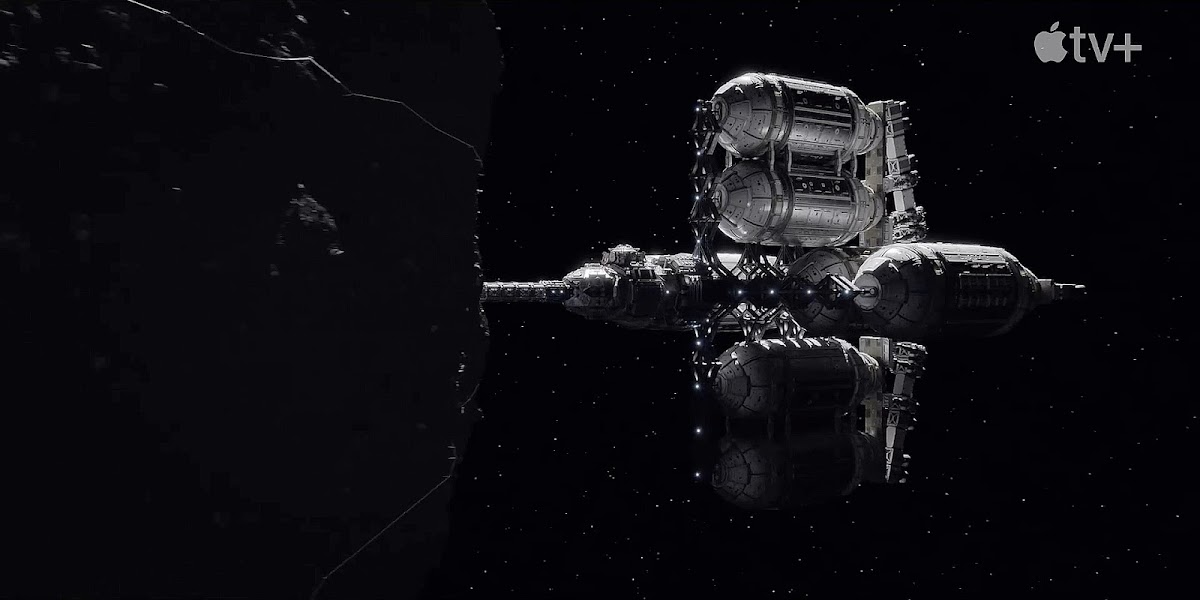
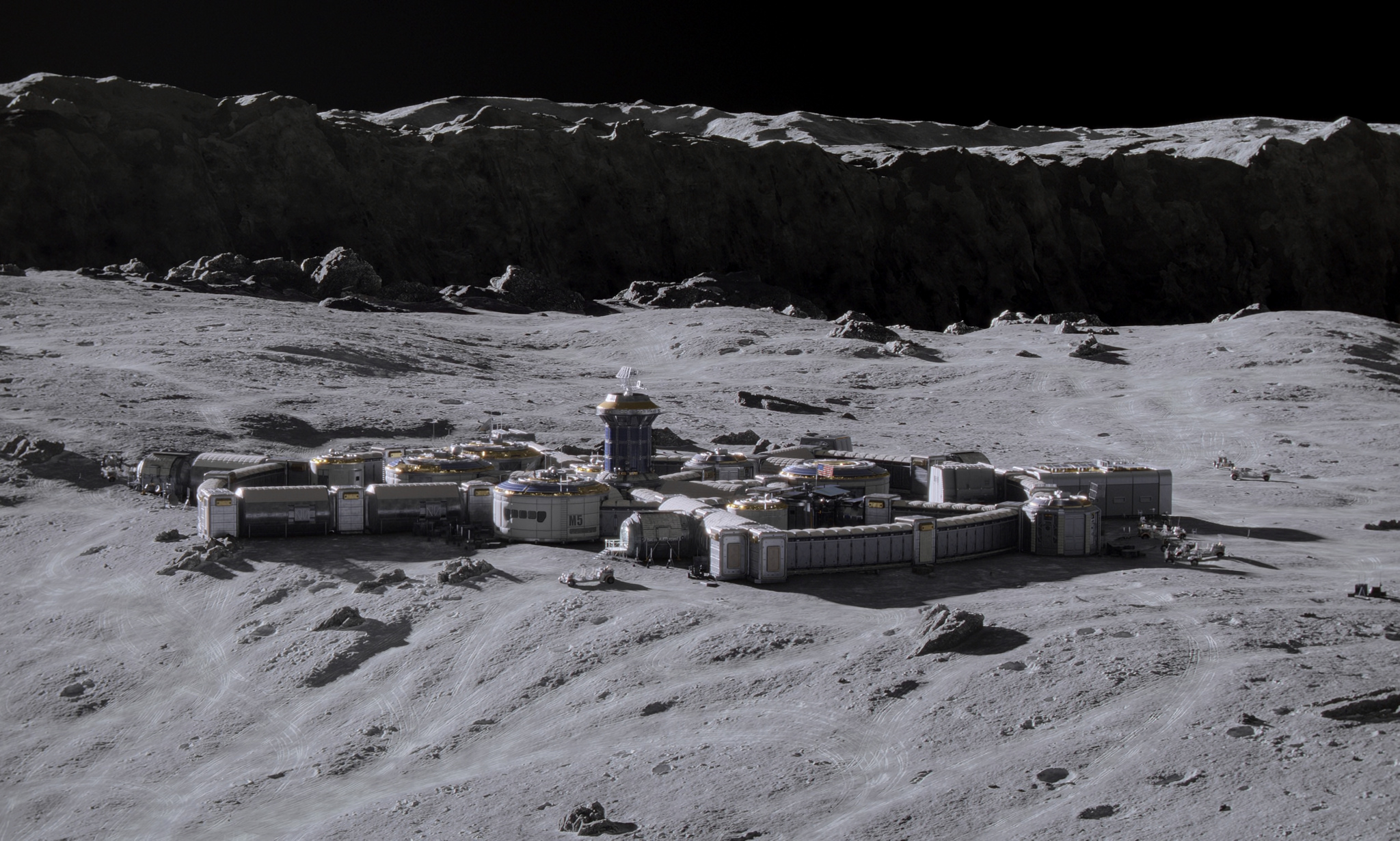
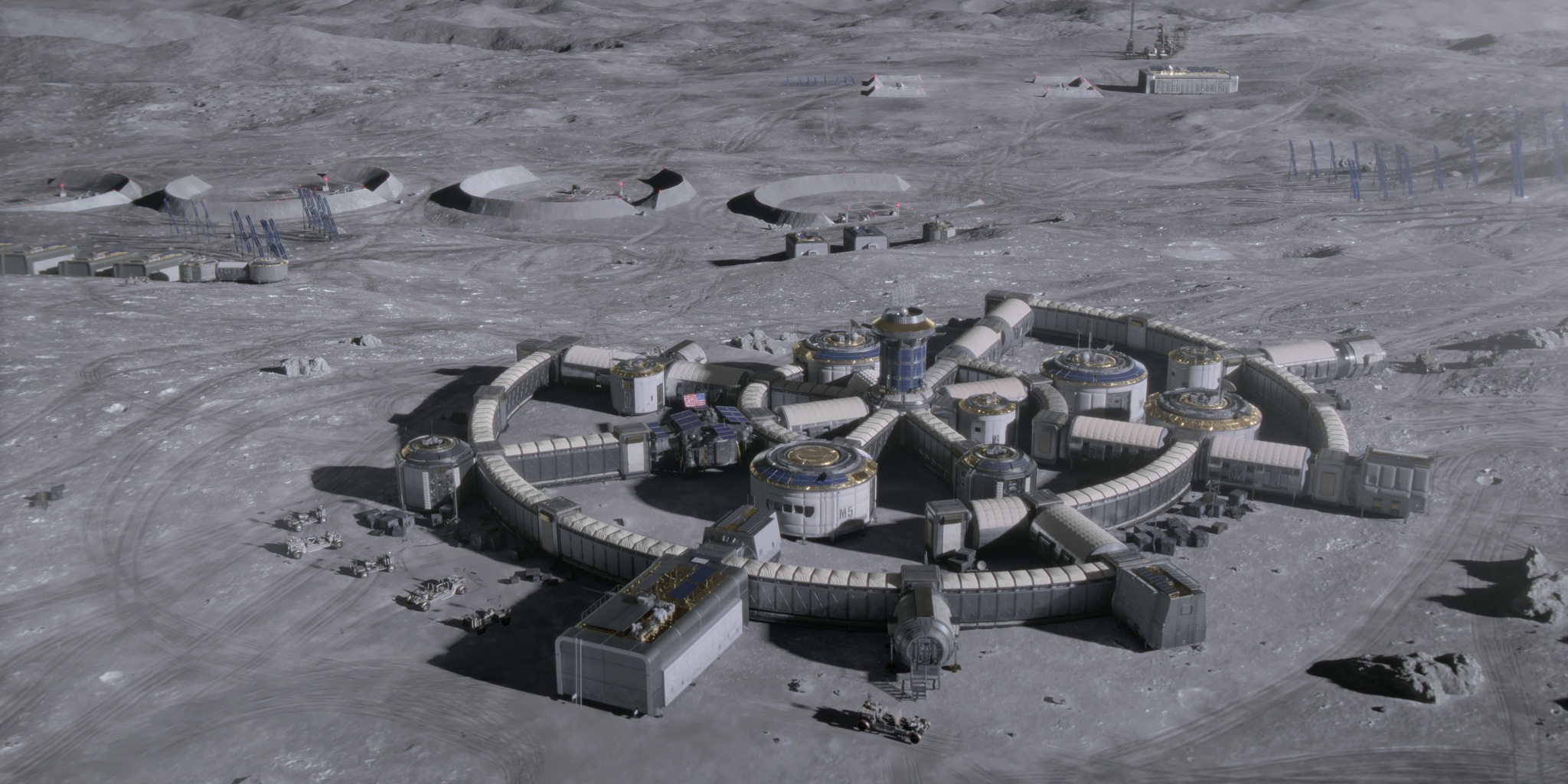
In season 5 of the alternate-history sci-fi series For All Mankind, set in an alternate 2012 where tensions between Martian colonists and their former home, Earth, reach boiling point, the international Happy Valley colony on Mars has grown into a settlement of more than five thousand residents. Happy Valley Base, located in Melas Chasma within the Valles Marineris system, was founded by NASA in 1995 during season 3. By season 4 (alternate 2003), it housed around 200 people.
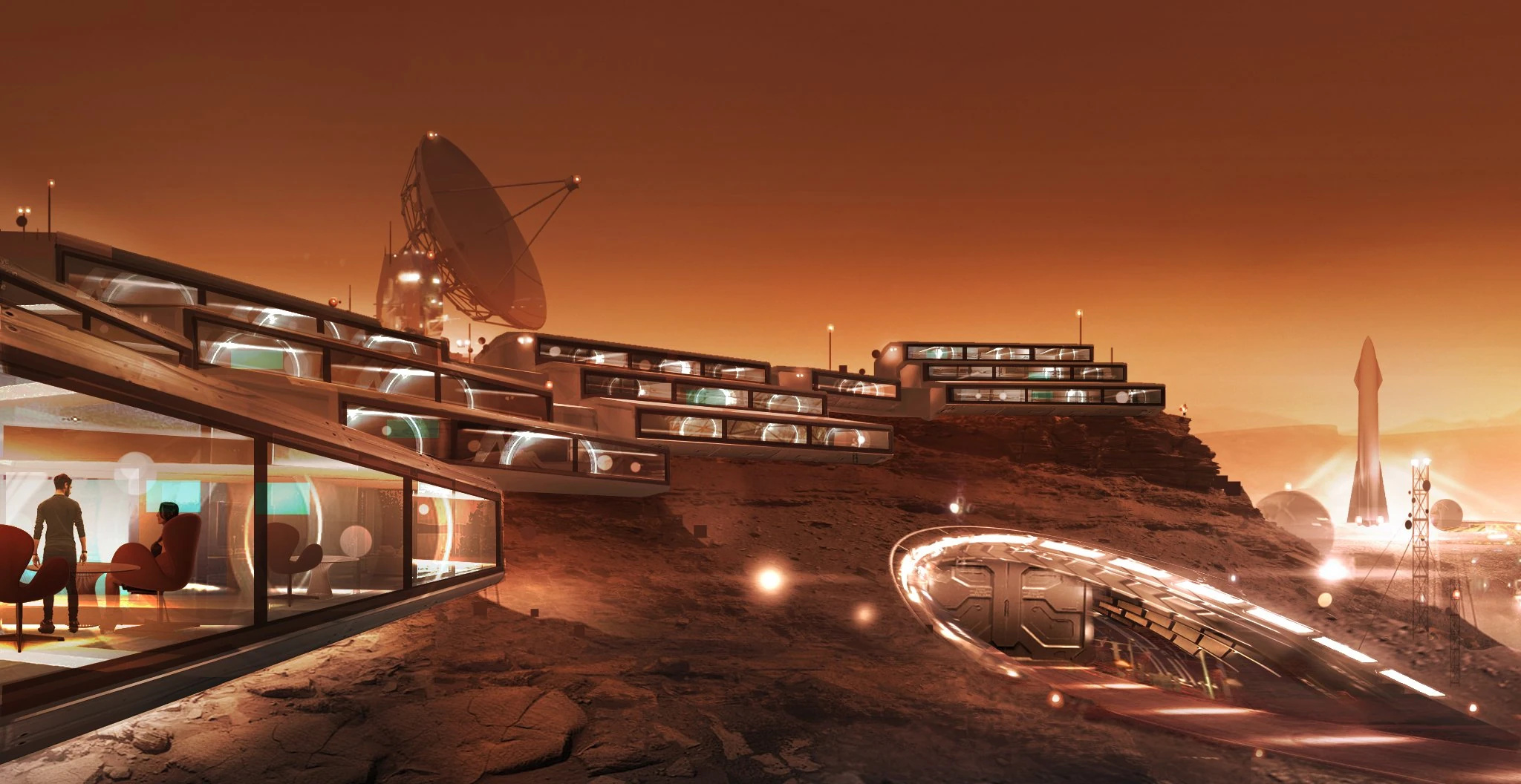
In the nine years since, Happy Valley, governed by the Mars-6 Alliance (US, USSR, ESA, India, Japan, and the Coalition of Communist Countries for Spaceflight), has expanded far beyond simple growth. The colony now supports a genuine multi-generational population and features a far larger and more interconnected complex: expanded power, communications, fuel, and regolith processing facilities, multiple large agrodomes (several already operational with more under construction), a developed spaceport, and the distinctive radiation shield tower system. The central hub includes arrival halls with rover airlocks, control and laboratory modules, warehouses, and living quarters. A noticeable addition is the emergence of civilian commercial and social spaces alongside the industrial backbone. Helios and its Soviet competitor Kuragin both maintain offices on Mars; Kuragin is actively building a space elevator.
For All Mankind runs on the premise of a never-ending space race in a timeline where the Soviets reached the Moon first. Each season leaps roughly a decade into an increasingly divergent reality: season 1 (1969–1974) sees rival US and Soviet lunar South Pole bases; season 2 (1983) escalates resource competition on the Moon; season 3 (1992–1995) brings private company Helios and North Korea into a four-way race to Mars; season 4 (2003) features Happy Valley workers redirecting the lithium-rich asteroid Goldilocks into Mars orbit after "stealing" it from the M-7 Alliance.
Here we have collected high-resolution screenshots from season 5 (sourced from 4K UHD and optimized for web). They show the colony's exteriors and interiors without major plot reveals. There are separate galleries for Happy Valley agrodomes, spaceport and the Helios' office.
Showing posts with label Alternate history. Show all posts
Saturday, June 27, 2026
Wednesday, February 25, 2026
Mars is ours! HD shots from "For All Mankind" season 5 trailer
In a teaser released in January Apple TV revealed that in season 5 of the alternate-history sci-fi TV series For All Mankind, the Happy Valley Base on Mars has grown into a thriving colony with thousands of residents. Two days ago the full trailer dropped, confirming that the friction between the Martian colonists and their former home, Earth, will be the central theme of season 5 - depicting the alternate year 2012.
For All Mankind is exploring the idea of never-ending space race if the Soviets had beaten the US in the race for the Moon, and the intention of the show is each season to jump about a decade further into the increasingly diverging reality of the show: in season 1, depicting alternate 1969 to 1974, both Soviets and US start building their separate bases near the lunar South pole; in season 2 (1983) both bases have been expanded and the superpowers compete for resources on the Lunar surface; in season 3 (1992 to 1995), Soviets and US are joined by a private company Helios and North Korea for a four-way race to be the first on Mars; in season 4 (2003) there is a sprawling international human base on Mars, but Martian rebels "steal" a large, lithium-rich asteroid, locking it in Martian orbit. Season 5 will start airing on March 27 on Apple TV.
Here you can watch the trailer and explore a set of high-resolution shots from it (downscaled from 4K UHD screens for better image quality):
For All Mankind is exploring the idea of never-ending space race if the Soviets had beaten the US in the race for the Moon, and the intention of the show is each season to jump about a decade further into the increasingly diverging reality of the show: in season 1, depicting alternate 1969 to 1974, both Soviets and US start building their separate bases near the lunar South pole; in season 2 (1983) both bases have been expanded and the superpowers compete for resources on the Lunar surface; in season 3 (1992 to 1995), Soviets and US are joined by a private company Helios and North Korea for a four-way race to be the first on Mars; in season 4 (2003) there is a sprawling international human base on Mars, but Martian rebels "steal" a large, lithium-rich asteroid, locking it in Martian orbit. Season 5 will start airing on March 27 on Apple TV.
Here you can watch the trailer and explore a set of high-resolution shots from it (downscaled from 4K UHD screens for better image quality):
In 9 years since the events in season 4 Happy Valley Base has grown into a real colony:
Dev Ayesa's Martian mansion:
Wednesday, January 21, 2026
Thousands are living on Mars in "For All Mankind" season 5
Today Apple TV released the first teaser for the long-awaited season 5 of For All Mankind alternate history sci-fi TV series. It was accompanied by several promotional photos from the season and a synopsis: "Season five of “For All Mankind” picks up in the years since the Goldilocks asteroid heist. Happy Valley has grown into a thriving colony with thousands of residents and a base for new missions that will take us even further into the solar system. But with the nations of Earth now demanding law and order on the Red Planet, friction continues to build between the people who live on Mars and their former home."
From the teaser it seems one of the underlying themes in season 5 will be Freedom.. Freedom on Mars.
For All Mankind is exploring the idea of never ending space race if Soviets would have beaten US in the race for the Moon and the intention of the show is each season to jump about a decade further into the increasingly diverging reality of the show: in season 1, depicting alternate 1969 to 1974, both Soviets and US start building their separate bases near the lunar South pole; in season 2 (1983) both bases have been expanded and the superpowers compete for resources on the Lunar surface; in season 3 (1992 to 1995), Soviets and US are joined by a private company Helios and North Korea for a four way race to be first on Mars; in season 4 (2003) there is a sprawling international human base on Mars and an unexpected side enters the race to get hold on a large, lithium-rich asteroid for mining. Season 5 will start airing on March 27 on Apple TV
Here you can watch the teaser and see the accompanying photos:
From the teaser it seems one of the underlying themes in season 5 will be Freedom.. Freedom on Mars.
For All Mankind is exploring the idea of never ending space race if Soviets would have beaten US in the race for the Moon and the intention of the show is each season to jump about a decade further into the increasingly diverging reality of the show: in season 1, depicting alternate 1969 to 1974, both Soviets and US start building their separate bases near the lunar South pole; in season 2 (1983) both bases have been expanded and the superpowers compete for resources on the Lunar surface; in season 3 (1992 to 1995), Soviets and US are joined by a private company Helios and North Korea for a four way race to be first on Mars; in season 4 (2003) there is a sprawling international human base on Mars and an unexpected side enters the race to get hold on a large, lithium-rich asteroid for mining. Season 5 will start airing on March 27 on Apple TV
Here you can watch the teaser and see the accompanying photos:
Happy Valley Base has been expanded a lot since season 4:
Alex Poletov (Ed's grandson) rides a motorcycle near the Happy Valley Base:
Free Mars graffiti are all over the Happy Valley Base:
Saturday, November 22, 2025
Set of paintings with scenes from "For All Mankind" TV series
French urban artist Colin Doublier has created a set of paintings with scenes from For All Mankind alternate history sci-fi TV series. For All Mankind is exploring the idea of never ending space race if Soviets would have beaten US in the race for the Moon and the intention of the show is each season to jump about a decade further into the increasingly diverging reality of the show: in season 1, depicting alternate 1969 to 1974, both Soviets and US start building their separate bases near the lunar South pole; in season 2 (1983) both bases have been expanded and the superpowers compete for resources on the Lunar surface; in season 3 (1992 to 1995), Soviets and US are joined by a private company Helios and North Korea for a four way race to be first on Mars; in season 4 (2003) there is a sprawling international human base on Mars and an unexpected side enters the race to get hold on a large, lithium-rich asteroid for mining. You can watch the show on Apple TV+. Season 5 should air soon.
Kuznetsov Station on Goldilocks in orbit around Mars in season 5:
Happy Valley Base on Mars in season 4:
Mars orbital station Phoenix in season 4:
Sunday, January 14, 2024
How to steal an asteroid .. "For All Mankind" season 4
It's possible our judgement is biased towards Mars-related content, but season 4 of For All Mankind alternate history sci-fi TV series is show's most exciting season yet. In season 4, depicting the alternate 2003, the international Happy Valley Base, founded in 1995 during season 3, has been significantly expanded and there are around 200 people living in it. We made a separate article with a large collection of high resolution shots depicting the exterior and interior of Happy Valley Base:
Mars base for 200 people in For All Mankind season 4
The main theme in season 4 is increasingly diverging visions for the purpose of human presence on Mars. For some it's only another contract job, but for others Mars is a new place to call "home". Add to the mix a once-in-a-lifetime opportunity to get hold on a large lithium-rich asteroid and increasingly strained relationships between the "upper class" (astronauts / cosmonauts, scientists and top executives) and contract workers literally living underground, and you have a recipe for a "Martian rebellion".
For All Mankind is exploring the idea of never ending space race if Soviets would have beaten US in the race for the Moon and the intention of the show is each season to jump about a decade further into the increasingly diverging reality of the show: in season 1, depicting alternate 1969 to 1974, both Soviets and US start building their separate bases near the lunar South pole; in season 2 (1983) both bases have been expanded and the superpowers compete for resources on the Lunar surface; in season 3 (1992 to 1995), Soviets and US are joined by a private company Helios and North Korea for a four way race to be first on Mars; in season 4 (2003) there is a sprawling international human base on Mars and an unexpected side enters the race to get hold on a large, lithium-rich asteroid for mining. You can watch the show on Apple TV+
Ahead there is a VISUAL RECAP OF SEASON 4, consisting of high resolution shots, downscaled from 4K UHD screens for better image quality. Be aware of heavy spoilers, revealing major story plots:
Mars base for 200 people in For All Mankind season 4
The main theme in season 4 is increasingly diverging visions for the purpose of human presence on Mars. For some it's only another contract job, but for others Mars is a new place to call "home". Add to the mix a once-in-a-lifetime opportunity to get hold on a large lithium-rich asteroid and increasingly strained relationships between the "upper class" (astronauts / cosmonauts, scientists and top executives) and contract workers literally living underground, and you have a recipe for a "Martian rebellion".
For All Mankind is exploring the idea of never ending space race if Soviets would have beaten US in the race for the Moon and the intention of the show is each season to jump about a decade further into the increasingly diverging reality of the show: in season 1, depicting alternate 1969 to 1974, both Soviets and US start building their separate bases near the lunar South pole; in season 2 (1983) both bases have been expanded and the superpowers compete for resources on the Lunar surface; in season 3 (1992 to 1995), Soviets and US are joined by a private company Helios and North Korea for a four way race to be first on Mars; in season 4 (2003) there is a sprawling international human base on Mars and an unexpected side enters the race to get hold on a large, lithium-rich asteroid for mining. You can watch the show on Apple TV+
Ahead there is a VISUAL RECAP OF SEASON 4, consisting of high resolution shots, downscaled from 4K UHD screens for better image quality. Be aware of heavy spoilers, revealing major story plots:
During season 4 interplanetary ships don't land directly on Mars; instead they dock to Phoenix, orbiting Mars, and the rest of the trip is made via small shuttles heading down to the surface:
Ed and Svetlana flying the asteroid capture ship Ranger:
Season 4 starts with an unsuccessful asteroid capture mission:
Wednesday, January 10, 2024
Mars base for 200 people in "For All Mankind" season 4
Season 4 of For All Mankind alternate history sci-fi TV series, depicting alternate 2003, "is really about the building of a new civilization on Mars" by the words of the co-creator of the series Ben Nedivi. The international Happy Valley Base, founded in 1995 during season 3 and located in Melas Chasma in the Valles Marineris canyon system on Mars, has been significantly expanded and there are around 200 people living in the base during season 4. The base is financed and operated by Mars-7 Alliance (consisting of US, USSR, ESA, North Korea, India, Japan, and the Coalition of Communist Countries for Spaceflight (CCCS)) and maintained by a private company Helios Aerospace.
Ground level of the base features several separate facilities for power generation, communications, fuel refinement, regolith processing, algae production, storage etc. and a central interconnected cluster of modules consisting of the Entrance hall for new arrivals with airlocks for the rovers, control rooms, laboratories, hydroponic farms, meeting rooms, warehouses / garages, a cafeteria, as well as the quarters for higher level personnel and astronauts / cosmonauts. The base has 5 underground sublevels, of which level 4 & 5 are still under construction in 2003 and not accessible. The sublevels house maintenance and storage rooms and additional quarters for workers. There is also a separate North Korean sector accessible only to North Koreans. The base also operates six landing pads for their orbital Hopper shuttles.
The design of the Happy Valley Base in For All Mankind is the most plausible design of a mid-sized human base on Mars that we have ever seen in a TV series or film.
For All Mankind is exploring the idea of never ending space race if Soviets would have beaten US in the race for the Moon and the intention of the show is each season to jump about a decade further into the increasingly diverging reality of the show: in season 1, depicting alternate 1969 to 1974, both Soviets and US start building their separate bases near the lunar South pole; in season 2 (1983) both bases have been expanded and the superpowers compete for resources on the Lunar surface; in season 3 (1992 to 1995), Soviets and US are joined by a private company Helios and North Korea for a four way race to be first on Mars; in season 4 (2003) there is a sprawling international human base on Mars and an unexpected side enters the race to get hold on a large, lithium-rich asteroid for mining.
Here we collected high resolution shots from season 4 (downscaled from 4K UHD screens for better image quality) depicting the exterior and interior of Happy Valley Base on Mars. No images revealing major story plots are included. We will make a separate article with season 4 story spoilers after the last episode will be released on January 12. [UPDATED:]
How to steal an asteroid .. "For All Mankind" season 4
Ground level of the base features several separate facilities for power generation, communications, fuel refinement, regolith processing, algae production, storage etc. and a central interconnected cluster of modules consisting of the Entrance hall for new arrivals with airlocks for the rovers, control rooms, laboratories, hydroponic farms, meeting rooms, warehouses / garages, a cafeteria, as well as the quarters for higher level personnel and astronauts / cosmonauts. The base has 5 underground sublevels, of which level 4 & 5 are still under construction in 2003 and not accessible. The sublevels house maintenance and storage rooms and additional quarters for workers. There is also a separate North Korean sector accessible only to North Koreans. The base also operates six landing pads for their orbital Hopper shuttles.
The design of the Happy Valley Base in For All Mankind is the most plausible design of a mid-sized human base on Mars that we have ever seen in a TV series or film.
For All Mankind is exploring the idea of never ending space race if Soviets would have beaten US in the race for the Moon and the intention of the show is each season to jump about a decade further into the increasingly diverging reality of the show: in season 1, depicting alternate 1969 to 1974, both Soviets and US start building their separate bases near the lunar South pole; in season 2 (1983) both bases have been expanded and the superpowers compete for resources on the Lunar surface; in season 3 (1992 to 1995), Soviets and US are joined by a private company Helios and North Korea for a four way race to be first on Mars; in season 4 (2003) there is a sprawling international human base on Mars and an unexpected side enters the race to get hold on a large, lithium-rich asteroid for mining.
Here we collected high resolution shots from season 4 (downscaled from 4K UHD screens for better image quality) depicting the exterior and interior of Happy Valley Base on Mars. No images revealing major story plots are included. We will make a separate article with season 4 story spoilers after the last episode will be released on January 12. [UPDATED:]
How to steal an asteroid .. "For All Mankind" season 4
Wednesday, November 8, 2023
Building a new civilization on Mars in "For All Mankind" season 4
Yesterday Apple TV+ released yet another video revealing more details about the upcoming season 4 of For All Mankind alternate history sci-fi TV series. As the co-creator of the series Ben Nedivi states in this featurette: "This season is really about the building of a new civilization on Mars. Last year in season 3 you saw the first explorers arrive on Mars. This season you're actually seeing hundreds of people up there and you're seeing, how civilization becomes civilization".
Judging from the reviews by journalists who were given early access to the first 7 episodes of season 4, this season might be the show's most exciting season yet. We look forward to judging it for ourselves. Season 4 premieres November 10 on Apple TV+, with episodes releasing weekly.
Some of the details for season 4 were previously revealed in a teaser and a trailer.
For All Mankind is exploring the idea of never ending space race if Soviets would have beaten US in the race for the Moon and the intention of the show is each season to jump about a decade further into the increasingly diverging reality of the show: in season 1, depicting alternate 1969 to 1974, both Soviets and US start building their separate bases near the lunar South pole; in season 2 (1983) both bases have been expanded and the superpowers compete for resources on the Lunar surface; in season 3 (1992 to 1995), Soviets and US are joined by a private company Helios and North Korea for a four way race to establish the first human base on Mars.
Here are some HD images from the featurette above.
Happy Valley base on Mars:
Friday, October 13, 2023
Asteroid mining will play a major role in "For All Mankind" season 4
Yesterday Apple TV+ published a yet unlisted trailer for season 4 of For All Mankind alternate history sci-fi TV series, revealing asteroid mining will play a major role in season 4, set in 2003. The trailer also revealed more details about the soon-to-be "self-sustaining" international Happy Valley base on Mars, first depicted in the first teaser for season 4 a month ago.
For All Mankind is exploring the idea of never ending space race if Soviets would have beaten US in the race for the Moon and the intention of the show is each season to jump about a decade further into the increasingly diverging reality of the show: in season 1, depicting alternate 1969 to 1974, both Soviets and US start building their separate bases near the lunar South pole; in season 2 (1983) both bases have been expanded and the superpowers compete for resources on the Lunar surface; in season 3 (1992 to 1995), Soviets and US are joined by a private company Helios and North Korea for a four way race to establish the first human base on Mars. Season 4 will start airing on November 10 on Apple TV+ and will depict the alternate 2003.
Here you can watch the trailer and see some HD images from it:
Happy Valley base on Mars:
Friday, September 15, 2023
"For All Mankind" season 4 reveals a sprawling first human base on Mars
On September 13 Apple TV+ released the first teaser for season 4 of For All Mankind alternate history sci-fi TV series. The teaser is made in the form of a recruitment ad for Helios Aerospace and reveals in season 4 of the show the company acts as a private operator and transport provider for the international Happy Valley base on Mars. Quite a resemblance to SpaceX in our reality 😉
For All Mankind is exploring the idea of never ending space race if Soviets would have beaten US in the race for the Moon and the intention of the show is each season to jump about a decade further into the increasingly diverging reality of the show: in season 1, depicting alternate 1969 to 1974, both Soviets and US start building their separate bases near the lunar South pole; in season 2 (1983) both bases have been expanded and the superpowers compete for resources on the Lunar surface; in season 3 (1992 to 1995), Soviets and US are joined by a private company Helios and North Korea for a four way race to establish the first human base on Mars. Season 4 will start airing on November 10 on Apple TV+ and will depict the alternate 2003 or so.
Here you can watch the teaser and see some HD images from it:
Helios recruitment posters:
Happy Valley Base overview:
Saturday, July 29, 2023
Jamestown US Moon base in "For All Mankind" season 3
Unlike the first two seasons, which focused on the Moon, season 3 of For All Mankind (an alternate history sci-fi TV series) focuses on Mars. But despite the Jamestown US Moon base being featured only briefly in the season, we can see it has been expanded significantly during the alternate history decade between season 2 (depicting 1983) and season 3 (depicting 1992 to 1995), completing the 1st ring of modules and adding a 2nd ring. So, in this alternate reality of the show development on the Moon has not been neglected because of the Mars mission.
NASA's Sojourner at Jamestown preparing for the mission to Mars:
Saturday, March 25, 2023
"For All Mankind" season 4 - concept art for Helios' Mars colony and space transport
In episode 9 of For All Mankind 3rd season Helios' CEO Dev Ayesa presented a vision for company's next generation spaceship, Mars orbital station and colonies on Mars, some of which we will most likely see realized in season 4 of the show which will air this autumn. We obtained high resolution concept images used in Dev's presentation, you can view further ahead.
For All Mankind is an alternate history sci-fi TV series exploring the idea of never ending space race if Soviets would have beaten US in the race for the Moon:
- In season 1, depicting alternate 1969 to 1974, both Soviets and US start building their separate bases near the lunar South pole;
- In season 2, depicting the alternate 1983, both bases have been expanded and the superpowers compete for resources on the Lunar surface;
- In season 3, depicting alternate 1992 to 1995, Soviets and US are joined by a private company Helios and.. North Korea for a four way race to establish the first human base on Mars.
Concept art for Helios' Mars colony:
Concept art for Helios' spaceship Calypso:
Concept art for Helios' Mars orbital space station Phoenix-T1:
Tuesday, August 16, 2022
"For All Mankind" season 3 brings space race to Mars
Soviets and US are joined by a private company Helios for a three way race to Mars in the alternate 1990s of For All Mankind season 3. The alternate history sci-fi TV series are exploring the idea of never ending space race if Soviets would have beaten US in the race for the Moon. In first two seasons of the show the focus was the Moon: in season 1, depicting alternate 1969 to 1974, both Soviets and US start building their separate bases near the lunar South pole; in season 2, depicting the alternate 1983, both bases have been expanded and the superpowers compete for resources on the Lunar surface.
The intention of the show is each season to jump about a decade further into the increasingly diverging reality of the show. Season 3 depicts alternate 1992 to 1995 when a race to establish first human base on Mars is facing various dangers for all of the participants. Here is a large collection of HD images from season 3 of the show. First part of the collection contains images with only minor spoilers, not revealing major story plots besides those already known from season 3 trailer.
The actual race starts with Helio's Phoenix launching from low Earth orbit, NASA's Sojourner from the Moon and Soviet Mars-94 directly from Earth:
Wednesday, May 25, 2022
3 way race to Mars in season 3 of "For All Mankind" alternate history TV series
For All Mankind is an alternate history sci-fi TV series exploring the idea of never ending space race if Soviets would have beaten US in the race for the Moon. In first two seasons of the show the focus was the Moon: in season 1, depicting alternate 1969 to 1974, both Soviets and US start building their separate bases near the lunar South pole; in season 2, depicting the alternate 1983, both bases have been expanded and the superpowers compete for resources on the Lunar surface.As hinted in the final scene of season 2 Mars will be the central stage in season 3 of the show. Recently released season 3 trailer shows that the Soviets and US are joined by a private company Helios for a three way race to Mars in 1995. Here you can watch the trailer and see some screenshots from it. The season 3 will start airing in June 10 on Apple TV+.
Helios' Mars mobile habitat:
3 rivals racing for Mars in season 3 of For All Mankind TV series:
NASA's spaceship arriving to Mars:
Subscribe to:
Posts (Atom)